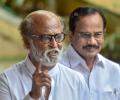
Rajinikanth's visible electoral strength is his constant mouthing of the term, 'aanmiga arasiyal', or 'spiritual politics', without he having to explain what it is. By implication, it is all that what Dravidian politics is not about. It may imply anti-corruption, being against Periyar's forgotten anti-god, anti-Brahmin dictum, but also ends up covering 'Tamil pride', which begins with Tamil language where, as a Maratha from Karnataka, he has more to defend himself. However, in the contemporary national context, aanmiga arasiyal is seen as a front for Rajini to market his brand of 'soft Hindutva' but identified even more with the BJP and Prime Minister Narendra Modi, in political terms, says N Sathiya Moorthy.

The ruling party's decision to serve 'disqualification' notice to three party MLAs when polling for four more assembly by-elections are due for May 19 may have been taken to keep the flock together post-results, rather than seek to lose more than already, but it has sent out alarming signals in a state ruled till recently by an Iron Lady, says N Sathiya Moorthy.
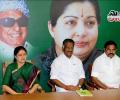
Ahead of VK Sasikala's return to Tamil Nadu on February 8, there are some important questions facing her. One, does she carry electoral weight more now than her brainchild AMMK had in the 2019 LS polls? Two, can she retain or build upon the five per cent vote-share from that time? And finally, is there space for Sasikala to retrieve, first within the AIADMK and then across the state, says N Sathiya Moorthy.
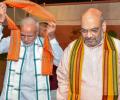
Prime Minister Narendra Modi and Home Minister Amit Shah will soon get around to reworking their organisational set-up and administrative priorities to regain lost ground in the wake of the Delhi electoral debacle, but there's third course available to them as well. That is to introduce the presidential form of government, which prime ministers Indira Gandhi and A B Vajpayee flirted with before abandoning it. Will Modi go further than them? N Sathiya Moorthy analyses the scenario.
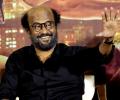
While critics and protestors have multifarious arguments to offer, the defence of CAA has been uni-dimensional and uni-focussed as has been the case with most policies of the Modi government and the political positions of his party. But to be drawn into an issue that has assumed more than local and national dimensions, Rajini has knowingly or otherwise, taken the plunge and in favour of the BJP -- or, so it has come to be seen, says N Sathiya Moorthy.
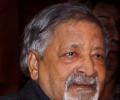
'I don't think you have anything to say to me and I certainly don't have anything to say to you.' Bharat Bhushan recalls his encounters with V S Naipaul.

'Some of his decisions were not so good, but his intentions were always guided by a deep national interest.'

The year 2014 has been an eventful one for India. The country got a new government and a new state, broke new frontiers in various fields and of course its share of controversies.
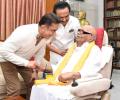
Today, when one Kamalahaasan launches a new political outfit, vowing to cleanse Tamil Nadu polity and political administration of corruption, mal-governance and non-governance, he is pitted not only against Rajini with his commitment to 'spiritual politics', he is also pitted against the real 'Lotus' in Tamil Nadu politics, representing the ruling BJP at the Centre, says N Sathiya Moorthy.

President Pranab Mukherjee on Monday addressed the first joint sitting of Parliament as mandatorily required under the Constitution after the general elections. The address is the political, economic and foreign policy road map of the Narendra Modi government and covers virtually all crucial areas.
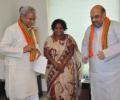
Having a young, untested leader makes sense for the Tamil Nadu BJP. But the new state president's immediate concern will be to gain acceptance within the state unit that is still in the grip of those with a strong RSS background, says N Sathiya Moorthy

Anti-nuclear activist S P Udayakumar, who has been called a threat to the economic security of India by the Intelligence Bureau, speaks to A Ganesh Nadar.

'Balakot and Pulwama will definitely help the BJP, but it will still not help them to create a 2014 like situation or go beyond that.'

Indeed, Prime Minister Narendra Modi, who as Gujarat chief minister was considered close to certain business groups and industrialists, has hardly been seen with any Indian business head.

If the Congress lost in Tamil Nadu in 1967, never to return, or the DMK and the AIADMK have kept their place in power and electoral politics since then, it owes not to their love or hatred for gods or for one religion over another. Instead, they had always been linked to performance and incumbency/anti-incumbency factors. There may be something in such constructs for Rajini's strategic team to consider, especially if the superstar is to enter direct politics by around this time next year. But then, they would need to brush up their homework more than at present, says N Sathiya Moorthy.

Former Watson Fellow and social entrepreneur Srikar Gullapalli talks about the issues affecting India's growth and tells us why he wants more people to actively participate in building a bright future and put India on the global map.

President Xi Jinping's visit may put relations between India and China on a new trajectory
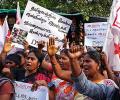
Why did such a 'socially conscientious' people adapt to cash-for-votes and the like, as fish to water? N Sathiya Moorthy offers an explanation.

Diplomats agree that amid stormy relations with China and Pakistan, Modi has posted impressive foreign policy successes, notes Aditi Phadnis.

At a time when the BJP is facing a perception battle, is Sambit Patra, its national spokesperson, helping the party's image?
.jpg)
We present Prime Minister Manmohan Singh's full speech as he addressed the country on the occasion of 66th Independence Day, from Red Fort, Delhi.
